
Visual Search for ecommerce
Find products through visual inspiration
Visual Search for ecommerce lets shoppers use visual input to discover products that are visually related to what they are looking for. Instead of relying only on product names or exact keywords, shoppers can start with an image and continue exploring the catalog through visual product discovery.
What is Visual Search?
Visual Search helps shoppers search with images, not only words
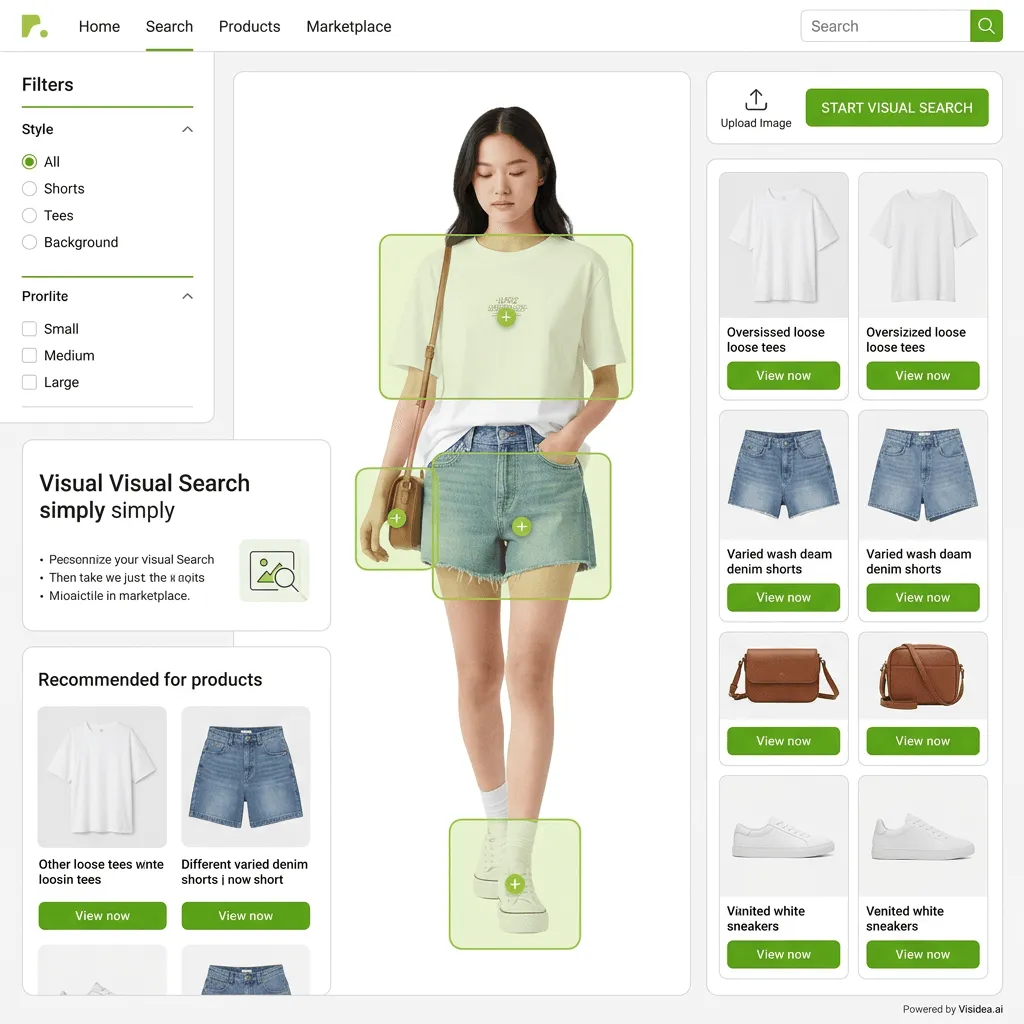
Visual Search in ecommerce is a product discovery method that uses visual input to help shoppers find products that are visually related to what they are exploring. Instead of requiring a shopper to describe an item with the right product name, attribute, or keyword, Visual Search makes the image itself part of the discovery process.
This differs from generic image search, which typically finds or retrieves images based on an image or associated information. Ecommerce Visual Search is focused specifically on discovering products within a commercial catalog.
It also complements traditional text search. Text search is useful when shoppers know what they want to describe—for example, “black leather shoulder bag.” Visual Search is useful when the shopper has visual inspiration but may not know the exact terminology used by the catalog.
Category navigation provides another route: shoppers progressively filter a catalog by predefined categories or attributes. Visual Search offers a different starting point.
For example, a shopper sees a jacket in a photo and wants something with a similar visual style. Rather than identifying the brand, product name, or technical attributes, they can use the image as the starting point for exploring related products in an ecommerce catalog.
Explore the visual discovery flow
From an image to product discovery
The Visual Search flow shows how image-based discovery fits into an ecommerce journey. Users can choose or use an image as their starting point, inspect products that are visually related, and continue exploring the catalog from the resulting products.
Functional cookies are off — turn them on to play this video.
Where Visual Search helps
Give shoppers another way to discover products
Visual discovery is particularly useful when shoppers begin with an image, a visual idea, or an existing product rather than a precise product description. It can complement established search and navigation patterns.
-
Search from visual inspiration
Shoppers often encounter products outside an ecommerce store before they know what to search for. Visual Search can provide an image-based entry point for turning that inspiration into product discovery within the catalog.
-
Discover similar products
A shopper can start from an existing visual reference and explore products that are visually related. This can support journeys where the desired product is not known by name but its appearance provides useful context.
-
Reduce reliance on exact product vocabulary
Product catalogs use specific terminology, while shoppers may use different words, or no words at all. Image-based discovery provides an alternative route when describing the desired product precisely is difficult.
-
Extend product exploration
Visual Search can create an additional path from inspiration to product pages and further catalog exploration. It can sit alongside text search, navigation, and recommendations as part of a broader product discovery experience.
Fashion
Visual product discovery for fashion and visually rich catalogs
Problem
Fashion and other visually rich ecommerce catalogs contain products whose appearance can be difficult to express through words alone. Shoppers may know the look, silhouette, pattern, material impression, or overall style they want without knowing the terminology used by the store. Traditional search and category navigation remain useful, but they may not fully capture an image-led shopping journey. The challenge for the merchant is to give visually oriented shoppers an additional way to move from inspiration to relevant products without depending entirely on exact vocabulary.
Solution
Visual Search can add an image-based discovery path to the existing ecommerce experience. A shopper can begin with a visual reference and use the resulting product set to explore the catalog. This approach can be particularly relevant for fashion, accessories, furniture, home decor, beauty, and other categories where appearance is an important part of product selection.
For you the practical question is not whether Visual Search should replace text search or navigation. It is how image-based discovery can complement those existing journeys. Implementation should consider the quality and consistency of catalog imagery, product information, available variants, the placement of the Visual Search experience, and the way results are evaluated. The appropriate setup depends on the catalog and the intended shopper journey.
- Visual Search Adoption 58%
Percentage of shoppers who use Visual Search, showing how effectively image-based discovery is adopted within the shopping experience.
- Product Discovery Engagement 37.9%
Percentage of Visual Search sessions that generate at least one interaction with a product in the search results.
- Product Discovery Conversion 5.4%
Percentage of Visual Search sessions that lead to a purchase, helping measure the contribution of image-based discovery to ecommerce sales.
What to evaluate
Seven factors to assess before implementing Visual Search
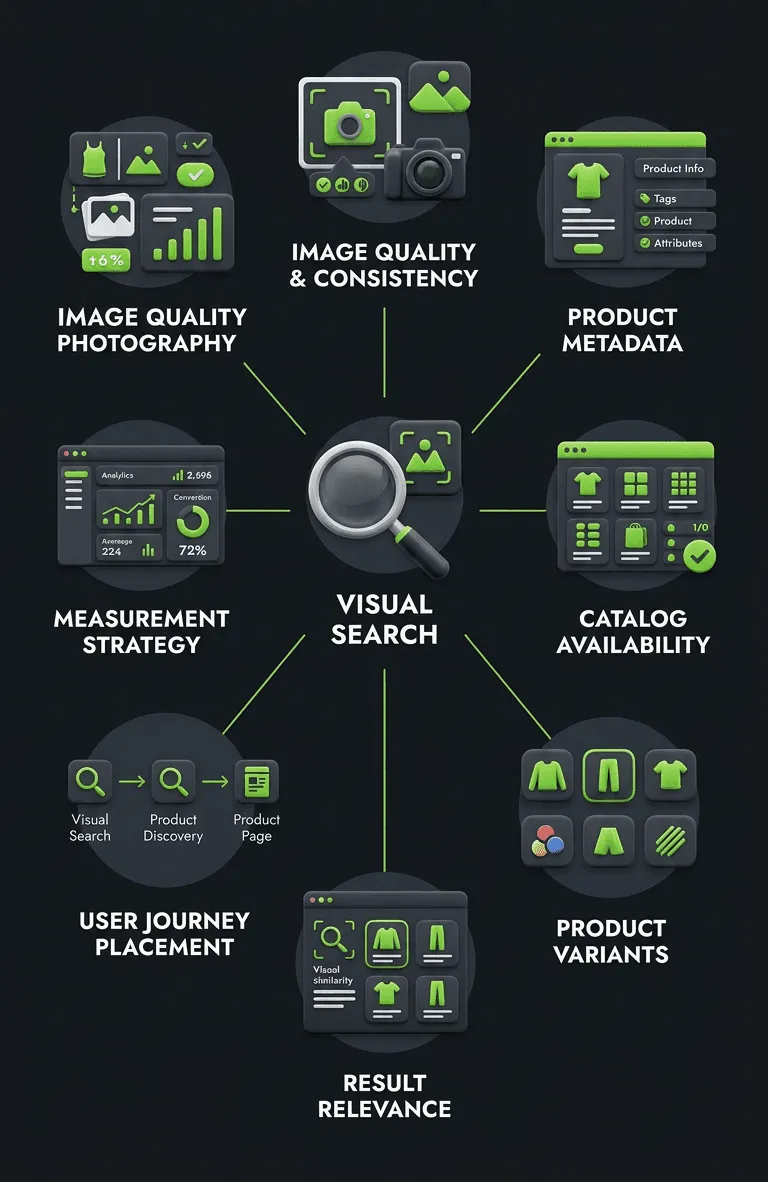
Requirements for Visual Search vary by catalog, product data, platform, and implementation. Before selecting or deploying a solution, you should evaluate:
- Image quality and consistency: Product images should provide useful visual information and be consistent enough to support the intended discovery experience. Consider image resolution, backgrounds, angles, cropping, and the number of images available per product.
- Product metadata: Product titles, descriptions, attributes, categories, and other catalog information can influence the broader discovery experience and should be assessed alongside imagery.
- Catalog availability: Determine which products, collections, markets, and inventory states should be available to visual discovery and how catalog updates are handled.
- Product variants: Define how colors, sizes, materials, or other variants are represented and whether the shopper should discover a specific variant or the parent product.
- Result relevance: Establish what “similar” means for the particular catalog and evaluate whether returned products match the intended visual relationship.
- User journey placement: Decide where visual search belongs in the storefront and how shoppers move from an image to results, product pages, filters, and subsequent discovery.
- Measurement strategy: Define the events and outcomes that will be monitored, such as usage, result interactions, product-page visits, and downstream ecommerce metrics where appropriate.

Visual Search and Semantic Search
Combine visual and language-based product discovery
Visual Search and Semantic Search address different ways shoppers express intent. Visual Search starts with an image or other visual reference. Semantic Search starts with natural-language text and is designed to interpret the meaning of a shopper's query rather than relying only on exact keyword matches.
Consider a shopper looking for a particular style of chair. They may have a photograph that represents the look they want, making visual search a natural starting point. Another shopper may describe the requirement in words, such as “a compact wooden chair for a modern dining room,” making natural-language search more appropriate.
For you, these approaches can coexist as different discovery paths within the same catalog. The appropriate combination depends on the products, customer behavior, storefront experience, and implementation requirements.
Learn more about language-based product discovery on the Visidea Semantic Search page.
Visual Search FAQ
Questions ecommerce teams ask about Visual Search
What is Visual Search in ecommerce?
Visual Search in ecommerce is a product discovery method that uses visual input as part of the search process. Instead of starting exclusively with a text query or category, shoppers can use an image as a reference for discovering visually related products in an ecommerce catalog.
How does Visual Search differ from image search?
Generic image search is typically designed to retrieve or discover images. Ecommerce Visual Search is specifically concerned with product discovery within a commercial catalog. Its purpose is to help shoppers move from a visual reference toward products that are relevant to the store's catalog.
Can shoppers find similar products from an image?
Visual Search can be used to present products that are visually related to an image used as a search reference. What constitutes a useful similarity relationship depends on the catalog, imagery, configuration, and implementation, so you should evaluate results using representative products and shopper journeys.
What product data is needed for Visual Search?
Requirements depend on the implementation. Product imagery is fundamental to an image-based discovery experience, while product identifiers and catalog information are needed to connect discovery results to ecommerce products. You should also consider metadata, variants, product availability, and catalog update processes.
Which ecommerce categories benefit from visual discovery?
Visual discovery can be relevant to categories where appearance is an important part of product selection, including fashion, accessories, furniture, home decor, and other visually rich catalogs. Suitability depends on the products, imagery, shopper behavior, and the intended use case.
How should I measure Visual Search?
Start by defining the role visual search is expected to play in the customer journey. Useful measures can include Visual Search? usage, interactions with results, product-page visits, and downstream ecommerce metrics where the necessary tracking is available. Measurement should compare results against a clearly defined baseline or test methodology.
Can Visual Search work alongside text search?
Yes. Visual Search and text search can serve complementary discovery intents. Shoppers who have an image can use visual discovery, while shoppers who can describe what they want can use text search. The appropriate relationship between the two depends on the storefront experience and implementation.
Explore product discovery
Continue exploring Visidea
Evaluate Visual Search
See how visual product discovery could fit your catalog
Book a Visual Search demo to explore the product experience and discuss your catalog, discovery requirements, and implementation context with the Visidea team.