
Email Recommendations for Ecommerce
Bring Relevant Product Discovery Into Ecommerce Email
Visidea Email Recommendations helps ecommerce teams include relevant product suggestions within customer email journeys. Depending on the implementation, recommendation blocks can use approved product, customer, consent, and message-context data to create a more useful path from an email to continued product discovery.
What are email recommendations?
What Product Recommendations in Email Actually Do
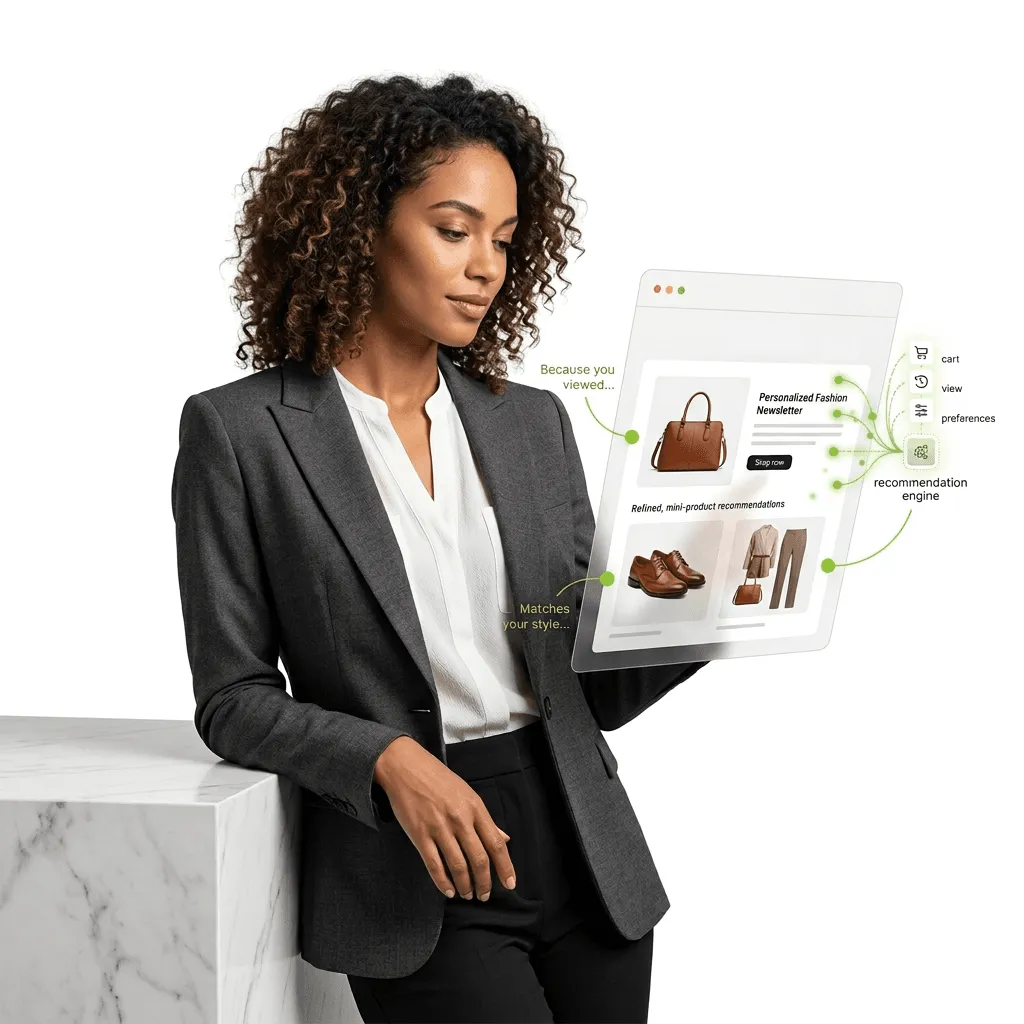
Ecommerce email recommendations are product suggestions displayed inside an ecommerce email message. They give customers an additional way to continue discovering products after leaving the storefront.
The recommendation layer is different from the systems and processes surrounding it. An email-service provider or campaign-delivery platform is responsible for creating, scheduling, or delivering email according to its own capabilities and configuration. A static merchandising block, by contrast, contains products that you have manually selected for a particular communication.
A product-recommendation block may instead be informed by approved product catalog data and, where permitted and appropriate, customer or journey context. For example, you might design a message containing the illustrative prompt: “Explore products related to the category you recently viewed.”
This is also distinct from onsite product recommendations, which appear within storefront experiences such as product pages, category pages, or other discovery interfaces.
The actual strategy depends on the ecommerce business. You need to determine the purpose of the message, which product information is suitable, whether customer context should be used, what permissions apply, and how the email fits into the wider customer journey.
See the email journey
See How Email Can Continue Product Discovery
This video illustrates a conceptual ecommerce email recommendation workflow, from an email containing a product recommendation module to a relevant ecommerce destination. It is an illustrative product-discovery scenario rather than a representation of a specific live customer implementation. The actual workflow, data sources, permissions, recommendation logic, and integration architecture depend on each ecommerce environment.
Functional cookies are off — turn them on to play this video.
Bring product discovery into email
Make Email Part of the Product Discovery Journey
Ecommerce email can extend a shopper journey beyond the website, but recommendation blocks are useful only when they support the purpose of the message. Their relevance depends on factors such as catalog quality, customer-data permissions, available context, and the surrounding marketing workflow. Recommendations should therefore contribute to the email experience rather than appear as generic promotional product lists.
-
Extend Product Discovery Beyond the Website
An email recommendation approach can give shoppers another path into the catalog after an onsite interaction or marketing touchpoint. The goal is to continue product exploration in a context that makes sense for the message, rather than treating email as an isolated promotional channel.
-
Match Recommendations to the Email Context
Recommendation logic should reflect the purpose of the communication. Depending on the implementation, you may define product-selection rules or use approved context to support different message types, while keeping the recommendation module aligned with the intent, content, and audience of the email.
-
Use Catalog-Aware Product Content
Where the required product data is available, recommendation modules can draw from catalog information relevant to the experience. Product identifiers, destinations, imagery, categories, availability information, or other attributes may need to be considered according to the implementation and the data sources approved by the ecommerce business.
-
Support Lifecycle and Merchandising Workflows
Email recommendations can support broader lifecycle and merchandising strategies when the required workflows, data, and permissions are in place. You can define where recommendation modules belong, which products are appropriate, and how email discovery should connect with the storefront experience that follows the click.
Illustrative ecommerce scenario
Continue a Shopper Journey With Relevant Product Discovery
Problem
Consider an illustrative situation in which a shopper has explored products or categories during an ecommerce journey. You want to create a useful follow-up experience rather than simply send another generic promotional message.
The challenge is deciding what kind of product discovery would make sense in the context of that communication. You may need to consider what the message is trying to achieve, which products are appropriate to show, which catalog information is available, and whether any customer context can legitimately and practically be used.
This scenario does not assume a particular behavioral trigger, customer profile, automation, email platform, industry, campaign type, or measurable outcome.
Solution
You could begin by defining the purpose of the message and identifying where a recommendation module would add value.
It could then determine which catalog inputs are required and which customer or journey context, if any, is approved and useful for that communication. Where the technical setup supports it, a recommendation module could be included within the business’s existing email workflow.
Before launch, you should validate whether recommended products are relevant to the message, whether the underlying product information is suitable for use, and whether each click leads to a coherent product page, category page, search experience, or campaign destination.
The experience can then be evaluated through the business’s approved measurement and experimentation framework. The appropriate metrics, attribution model, testing method, and governance process depend on the organization’s objectives and existing marketing environment.
- Email Click-Through Rate 1.8%
Share of delivered ecommerce emails generating a click toward the next product-discovery experience.
- Recommendation Click Rate 3.75%
Benchmark for email clicks associated with AI-powered product recommendations.
- Top-Performer Click Rate 8.79%
Click rate reported for top-performing AI-powered recommendation implementations.
Where email recommendations fit
Connect Email With the Wider Ecommerce Discovery Journey
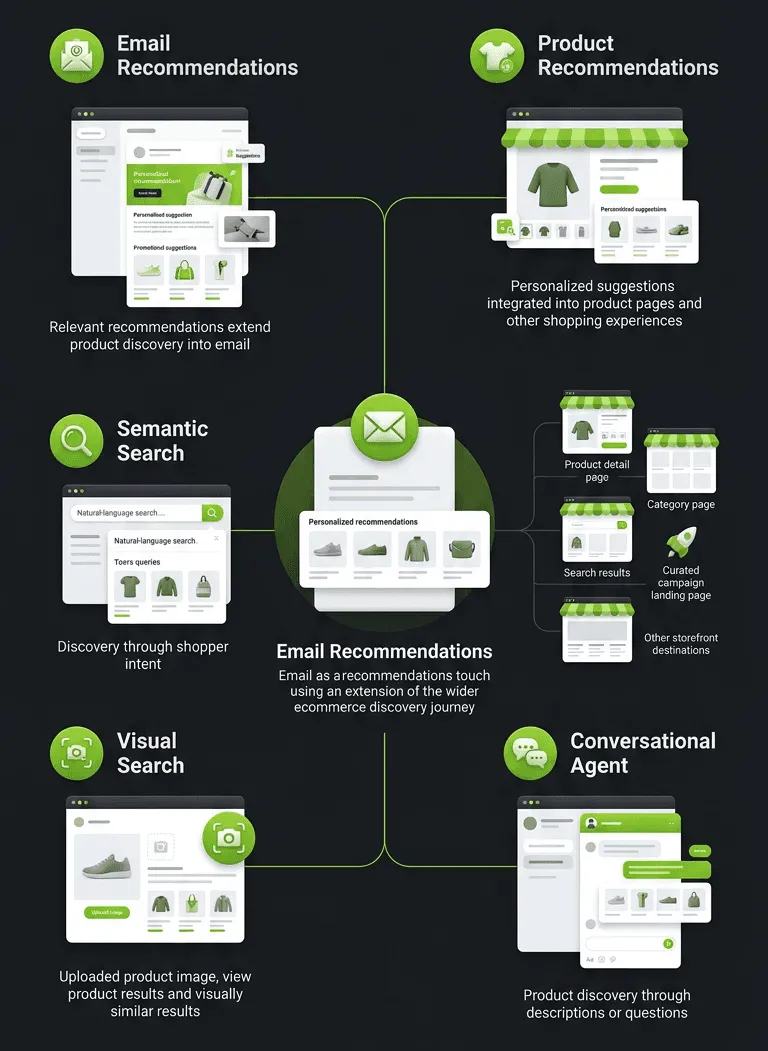
Product discovery can happen across multiple ecommerce touchpoints. Customers may explore a catalog through onsite search, category navigation, product detail pages, recommendations, visual interfaces, conversational experiences, and approved lifecycle or marketing communications.
Email Recommendations extend that journey into email by presenting product suggestions that are appropriate to the message context. The destination matters as much as the email itself. A recommended item might lead to a product page, while another discovery experience could continue through a category page, search result, curated campaign page, or another relevant storefront destination.
Product Recommendations can support product discovery within ecommerce experiences and, depending on the implementation, may also inform recommendation modules used elsewhere.
Semantic Search helps customers discover products through natural-language queries, while Visual Search supports discovery using an image as the starting point.
A Conversational Agent can provide another discovery interface for shoppers who want to describe what they are looking for or ask questions during their journey.
Email Recommendations complement these experiences rather than replace them. The recommendation logic and creative message should remain aligned with the purpose of each email and the experience customers reach after clicking.
The specific combination of capabilities depends on each implementation. You should not assume that every Visidea component, data source, or journey is automatically connected. The Visidea platform provides the broader context for evaluating how different product-discovery capabilities may fit together.
What to evaluate before implementation
Plan the Data, Journey, and Integration Before You Build
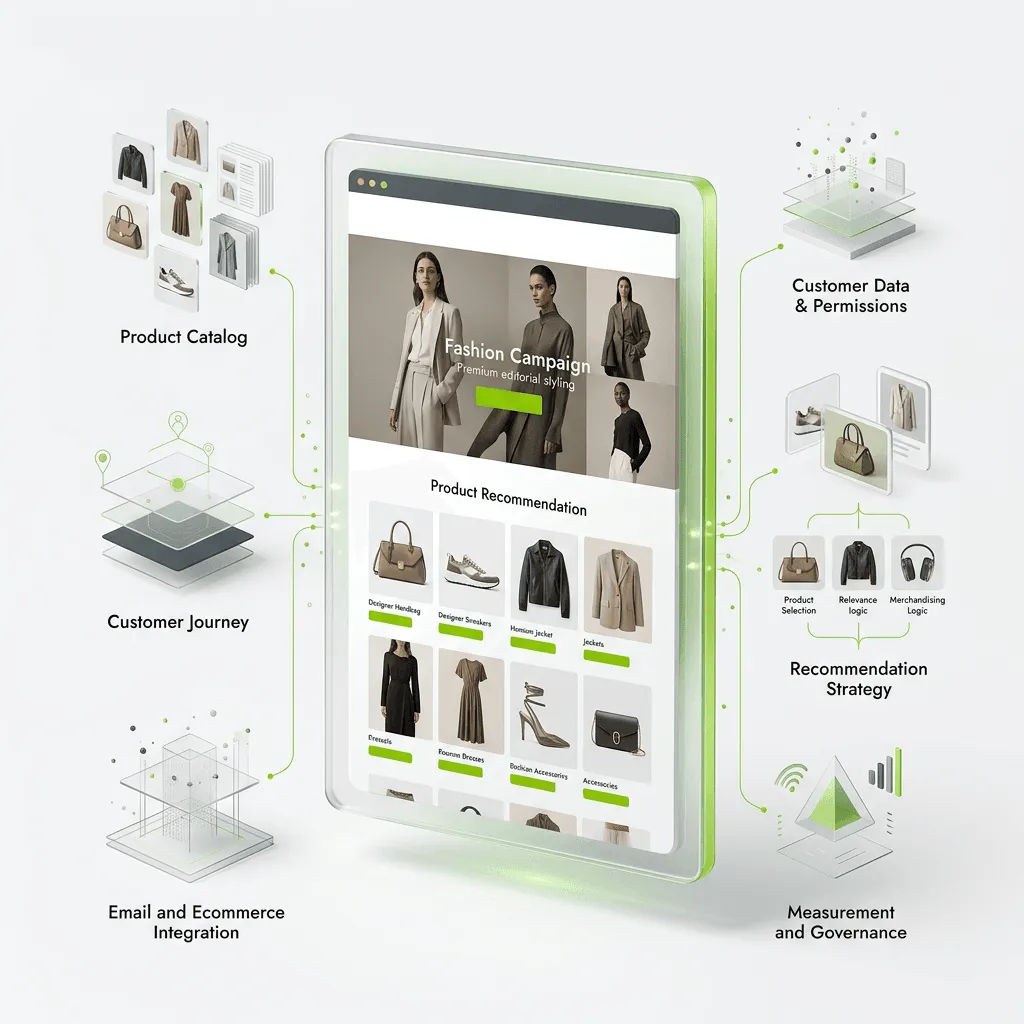
Email recommendations sit inside a wider marketing, data, catalog, and ecommerce environment. Before implementation, you should define the customer experience they want to create and understand the systems, permissions, product data, workflows, and governance requirements involved.
- Email purpose and customer journey: Define what the communication is intended to do and where recommendations belong within that journey. Marketing communications and operational or transactional messages may have different objectives, responsibilities, data requirements, and governance considerations.
- Product catalog quality and availability: Confirm that the product information required by the recommendation experience is accurate and usable. Depending on the design, this may include identifiers, titles, images, URLs, categories, merchandising attributes, availability, pricing, or other approved catalog fields.
- Approved customer data and permission model: Determine whether the experience requires customer-level context and which data, if any, can be used. Data usage, consent, privacy, profiling, and applicable legal requirements should be assessed by the business with Legal, Privacy, or other responsible teams where appropriate.
- Email platform and integration architecture: Map how recommendation data would move between the catalog, recommendation layer, ecommerce platform, and existing email environment. Confirm technical responsibilities, supported interfaces, rendering constraints, caching behavior, and what happens when required information is unavailable.
- Recommendation strategy and merchandising controls: Decide how products should be selected for each message context. You may need rules governing eligible products, exclusions, categories, campaign priorities, fallback logic, or manual merchandising controls, depending on the implementation.
- Creative, landing-page, and customer-experience continuity: Ensure the recommendation block fits naturally within the email creative and leads to a coherent destination. Product messaging, imagery, calls to action, landing pages, and storefront discovery should support the same customer objective.
- Measurement, experimentation, and governance: Define what the organization wants to evaluate before launch. Agree on approved metrics, testing methodology, attribution boundaries, ownership, monitoring, and decision processes without assuming that any one metric alone represents the full value of the experience.
The final scope should reflect the actual customer journey, product catalog, email stack, approved use of data, organizational responsibilities, and business priorities. A narrower implementation with clearly defined inputs and ownership is often easier to evaluate than a broad recommendation program built on assumptions.
Frequently asked questions
Email Recommendations: Questions Ecommerce Teams Ask
What are ecommerce email recommendations?
Ecommerce email recommendations are product suggestions displayed inside an email to create an additional path into the product catalog. They can be selected manually or generated through a recommendation process, depending on the implementation. The products shown, data used, message type, and delivery process should be defined by the ecommerce business. Where customer information is involved, the organization should also assess permissions, privacy requirements, and appropriate data use with the relevant internal teams.
How are email recommendations different from onsite product recommendations?
Onsite product recommendations appear within the ecommerce experience, such as on product detail pages, category pages, carts, or other storefront interfaces. Email recommendations appear inside an email communication and need to work within the email platform, campaign context, and destination journey. The two can follow related merchandising or recommendation principles, but they operate in different environments. Teams should separately define the data, permissions, technical responsibilities, and measurement approach required for each channel.
Do email recommendations require customer data?
Not necessarily. A recommendation block can be designed around product, campaign, category, merchandising, or other non-individual context, depending on the desired experience. Individual-level customer context may support other approaches where the required data, permissions, and technical setup are available. The ecommerce business should determine what information is appropriate to use and assess privacy, consent, profiling, and message-type requirements with Legal, Privacy, Security, and other responsible teams where applicable.
Can email recommendations be used without individual-level personalization?
Yes. Product recommendations in email do not inherently require individual-level personalization. You could use campaign-specific products, curated collections, category-based recommendations, merchandising rules, or other contextual approaches where supported by the implementation. The appropriate strategy depends on the purpose of the message and the available catalog inputs. If customer-level information is introduced, the business should separately evaluate permissions, privacy requirements, data responsibilities, and the role of its email and customer-data systems.
What product catalog data is needed for email recommendations?
The requirements depend on what the recommendation module needs to display and how products are selected. Common inputs may include product identifiers, titles, images, destination URLs, categories, merchandising attributes, pricing, or availability information, but these should not be assumed for every implementation. You should identify which fields are required, how current they need to be, and which system is responsible for supplying them. Catalog quality and consistency should be validated before the experience is launched.
How do email recommendations fit with an email-service provider?
An email recommendation capability and an email-service provider perform different roles. The recommendation layer can provide product-selection or recommendation content, while the existing email environment may remain responsible for campaign execution, subscriber management, and delivery. The exact architecture depends on the systems involved and the interfaces they support. Ecommerce and technical teams should confirm integration responsibilities, rendering requirements, data flows, message types, permissions, and fallback behavior before implementation.
What should I consider about consent and privacy?
You should first identify what data the recommendation experience would use, why it is needed, how it moves between systems, and whether the message is marketing, operational, transactional, or another communication type. Applicable consent, privacy, profiling, retention, and data-processing requirements vary by organization and jurisdiction. These questions should be assessed by the ecommerce business with its Legal, Privacy, Security, and other responsible teams. An email recommendation system should not be assumed to manage consent, unsubscribe requests, or legal compliance.
How should I measure an email recommendation experience?
Measurement should start with the purpose of the email and the customer journey the recommendation module is intended to support. You may evaluate interaction with recommendations, downstream product exploration, campaign behavior, or other approved business metrics, depending on their analytics environment. You should define attribution rules, comparison methods, testing design, and ownership before drawing conclusions. Performance should not be assessed through a single metric in isolation, and the measurement framework should reflect both the email experience and the destination journey.
Continue exploring
Explore the Rest of the Product Discovery Journey
Bring product discovery into your email journeys
Discuss Email Recommendations for Your Ecommerce Journey
Talk with Visidea about your ecommerce catalog, customer journeys, email environment, and recommendation objectives. We can review where product recommendations may fit, which data and systems need to be considered, and what should be validated before defining an implementation.