
Conversational Agent for Ecommerce
One Agent for Product Discovery and Customer Support
Visidea Conversational Agent helps shoppers find products and get answers about your business through natural conversation. It detects whether a request is about product discovery or customer support, then responds using the appropriate ecommerce data and knowledge sources you make available through the Visidea dashboard.

What is a conversational agent for ecommerce?
Understand What the Shopper Needs Before Choosing the Answer
Visidea Conversational Agent is an ecommerce AI assistant designed to handle both product-discovery questions and customer-support questions in a single conversational interface.
A shopper might ask, “I need a waterproof jacket for commuting by bike,” then later ask, “What is your return policy?” These are different intents and require different information.
The agent detects the intent behind the conversation and responds accordingly.
For product-discovery requests, the conversation can help shoppers express needs, preferences, use cases, styles, or constraints in natural language and navigate toward relevant products.
For customer-support questions, Visidea can use retrieval-augmented generation, or RAG, to retrieve relevant information from knowledge sources provided by the ecommerce owner before generating an answer.
Merchants can add documents such as PDF, Word, TXT, and Markdown files, as well as webpages, to the Visidea dashboard. These sources can contain information such as policies, buying guides, product documentation, FAQs, company information, or other content that shoppers may need during their journey.
This creates a conversational layer that can support discovery and information requests without forcing customers to decide in advance whether they need search, navigation, or support.
See the conversational journey
One Conversation, Different Customer Intentions
This illustrative workflow shows how an ecommerce conversation can move from product discovery to customer support. The agent identifies the intent behind each request and uses either the product-discovery flow or information retrieved from merchant-provided knowledge sources. The example is conceptual and does not represent a specific customer implementation.
Functional cookies are off — turn them on to play this video.
One conversational layer
Respond Differently Based on What the Customer Is Asking
Ecommerce conversations can move between product needs and informational questions. A visitor may ask for help finding the right product, request clarification about a feature, or ask about company policies. Visidea detects the intent of the conversation and uses the relevant source of information to respond.
-
Product discovery through conversation
Shoppers can describe what they are looking for using natural language instead of relying only on exact product names, categories, or catalog terminology. The Conversational Agent can use that intent as a starting point for product discovery and help users navigate toward relevant products.
-
Customer-support answers with RAG
When a shopper asks an informational or support question, the agent can retrieve relevant content from the knowledge sources configured by the merchant and use that information to generate a contextual answer.
-
Automatic intent detection
The agent analyzes the conversation to identify whether the shopper is looking for products or asking for information. This allows the same interface to route different types of questions toward the appropriate discovery or knowledge-retrieval process.
-
Build a knowledge base from your content
You can add sources such as PDF, Word, TXT, and Markdown documents, together with webpages, through the Visidea dashboard. These sources provide the knowledge the agent can retrieve when answering relevant customer-support questions.
Illustrative ecommerce scenario
From “What Should I Buy?” to “Can I Return It?”
Problem
A shopper arrives on an ecommerce site looking for a product but does not know the exact category or product terminology.
They might start with: “I need a lightweight waterproof jacket that I can use for cycling to work.”
After exploring suitable products, another question may arise: “How long do I have to return it?”
In many ecommerce experiences, these two questions lead to completely separate journeys. The first belongs to search and product discovery, while the second may require the visitor to find an FAQ, help center, policy page, or customer-service channel.
The customer, however, sees both questions as part of the same shopping journey.
Solution
Visidea Conversational Agent provides a single conversational entry point for both types of requests.
When the shopper expresses a product need, the agent can recognize product-discovery intent and use the request to help identify relevant items in the catalog.
When the conversation shifts to a customer-support question, the agent can detect the new intent and use RAG to retrieve relevant information from the merchant’s configured knowledge sources.
For example, a returns question could be answered using an uploaded policy document or relevant webpage included in the Visidea knowledge base.
This allows the conversation to follow the customer’s actual journey rather than requiring the shopper to understand which ecommerce system, page, or interface contains the answer.
The quality of each response still depends on the catalog information and knowledge sources supplied by the merchant.
- Self-Service Resolution Rate 14%
Customer-service issues fully resolved through self-service.
- AI Support Containment 42%
Retail and ecommerce conversations resolved by AI without escalation.
- Ecommerce Conversion Rate 1.69%
Median conversion rate benchmark for Apparel & Accessories stores.
Part of a broader discovery experience
Combine Conversation With Search, Visual Discovery and Recommendations
Ecommerce customers do not always begin their journey in the same way.
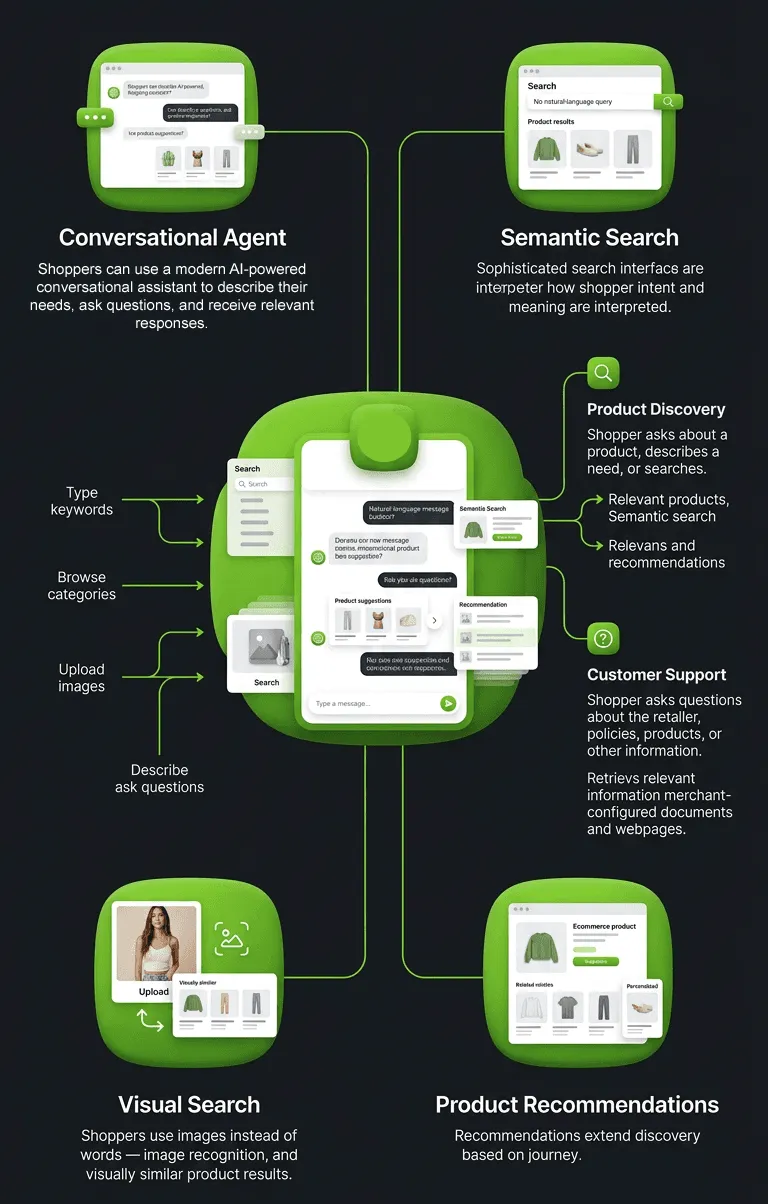
One visitor may type a precise keyword. Another may browse categories and filters. Someone may have an image of the style they want. Another shopper may describe a need in a sentence. And during any of those journeys, the customer may also have questions about the retailer, products, policies, or other information.
The Conversational Agent provides a natural-language interface across these situations. It can distinguish product-discovery requests from customer-support questions and use the appropriate information source for each intent.
Semantic Search helps interpret natural-language product queries and connect them with relevant catalog items.
Visual Search provides another discovery path when shoppers can communicate what they want more effectively through an image.
Product Recommendations and similar-product experiences help users continue discovering items based on the context of the shopping journey.
The Conversational Agent adds another interaction layer by allowing customers to ask questions directly. Product-oriented questions can become discovery requests, while support questions can be answered using information retrieved from documents and webpages configured by the merchant.
These capabilities can complement one another, although the exact customer journey and configuration depend on each implementation.
Explore the Visidea platform to see how these product-discovery approaches can support different ecommerce journeys.

What to evaluate before implementation
Prepare Your Catalog and Knowledge Base for Conversational Commerce
A useful conversational experience depends on more than the chatbot interface. You should first define which customer questions the agent should handle, which information should support those answers, and how product-discovery requests differ from informational or customer-support requests.
- The shopper problems to solve: Identify the product-discovery and support questions customers regularly face. Define which journeys should be handled conversationally and which requests should remain outside the scope of the agent.
- Product catalog quality and completeness: Product discovery depends on the information available in the ecommerce catalog. Review product titles, descriptions, categories, attributes, and other fields to ensure they contain useful information about the products shoppers are trying to find.
- Product terminology and taxonomy: Compare internal catalog terminology with the language customers actually use. Shoppers may describe use cases, occasions, styles, problems, or desired outcomes rather than using your predefined product categories.
- Knowledge sources for customer support: Determine which documents and webpages should be available to the agent. Relevant material may include FAQs, policies, product documentation, buying guides, company information, or other content customers commonly need.
- Information scope and source quality: Review every source included in the knowledge base. Outdated, contradictory, incomplete, or ambiguous content can affect the usefulness of RAG-based answers, so ownership and content maintenance should be clearly defined.
- Measurement, review, and iteration: Evaluate both product relevance and answer quality using representative customer questions, user testing, conversation analysis, and appropriate behavioral metrics. Review failures and ambiguous queries regularly to improve catalog data and knowledge sources.
Frequently asked questions
Questions About Visidea Conversational Agent
What is a conversational agent for ecommerce?
An ecommerce conversational agent lets customers interact with an online store using natural language. Visidea Conversational Agent can handle both product-discovery requests and customer-support questions. It detects the intent behind the conversation and uses the appropriate process to respond. Product-related requests can support product discovery, while informational questions can use RAG to retrieve relevant information from knowledge sources configured by the ecommerce owner, including documents and webpages.
How is a conversational agent different from ecommerce search?
Ecommerce search is primarily designed to retrieve products from a catalog based on a query. A conversational agent can handle a broader interaction. Shoppers can describe a product need naturally, but they can also ask informational questions such as policies, product guidance, or company-related questions. Visidea distinguishes these intents so a product-discovery request can use catalog information while a support question can use the merchant’s RAG knowledge base.
How is a conversational agent different from a customer-service chatbot?
A traditional customer-service chatbot is generally focused on informational or support interactions. Visidea Conversational Agent combines customer-support capabilities with ecommerce product discovery. A shopper can ask what product fits a particular need and then continue the same conversation with a question about the retailer or its policies. Intent detection allows the agent to determine which type of request it is handling and select the appropriate source of information.
Can the agent help shoppers find products?
Yes. Shoppers can describe what they need using natural language, including their intended use, preferences, style, constraints, or desired outcome. Visidea can recognize these requests as product-discovery intent and use them to help the customer navigate toward relevant products. The effectiveness of product discovery depends on the quality and completeness of the ecommerce catalog and the product information available to the system.
What information can be added to the RAG knowledge base?
Ecommerce owners can add knowledge sources through the Visidea dashboard. Supported content can include PDF documents, Word files, TXT files, Markdown files, and webpages. These sources can contain information such as FAQs, policies, product documentation, buying guides, company information, or other content useful for customer questions. The quality of generated answers depends on the accuracy, completeness, consistency, and relevance of the content included in the knowledge base.
How does intent detection work in the conversation?
Visidea analyzes the customer’s request to determine the type of information being requested. A query about finding or choosing products can be treated as product-discovery intent, while a question about company information, policies, documentation, or other support topics can be handled through the RAG knowledge base. The detected intent allows different kinds of questions to be managed within the same conversational interface rather than requiring customers to choose a separate tool.
Can the conversation switch between product discovery and customer support?
Yes. A customer journey can contain multiple intents. A shopper might begin by asking for a product recommendation, continue by asking about a particular product, and then ask about a return policy or other company information. Visidea can detect the intent of each part of the conversation and respond using the appropriate source. This allows product discovery and informational support to coexist within the same customer interaction.
How should I measure a conversational ecommerce experience?
You should evaluate product discovery and customer-support interactions separately as well as together. For discovery questions, review whether resulting products are relevant to the shopper’s stated need. For RAG-based support questions, review whether answers accurately reflect the supplied source material. Conversation analysis, representative test questions, user testing, product engagement, answer-quality review, and identification of unanswered or ambiguous questions can help you improve both catalog data and knowledge content.
Continue exploring
Explore the Rest of the Visidea Discovery Platform
Explore conversational ecommerce
Bring Product Discovery and Support Into One Conversation
Discuss your ecommerce catalog, customer questions, existing support content, and discovery journeys with Visidea. See how the Conversational Agent can use intent detection to handle product requests and RAG to answer relevant questions from the documents and webpages you make available.