
Product Recommendations
Help shoppers discover more products from your catalog
Product Recommendations and similar-product experiences give shoppers additional ways to explore an ecommerce catalog after they find a product. Visidea add discovery surfaces that connect shoppers with relevant alternatives and related catalog options across the shopping journey.
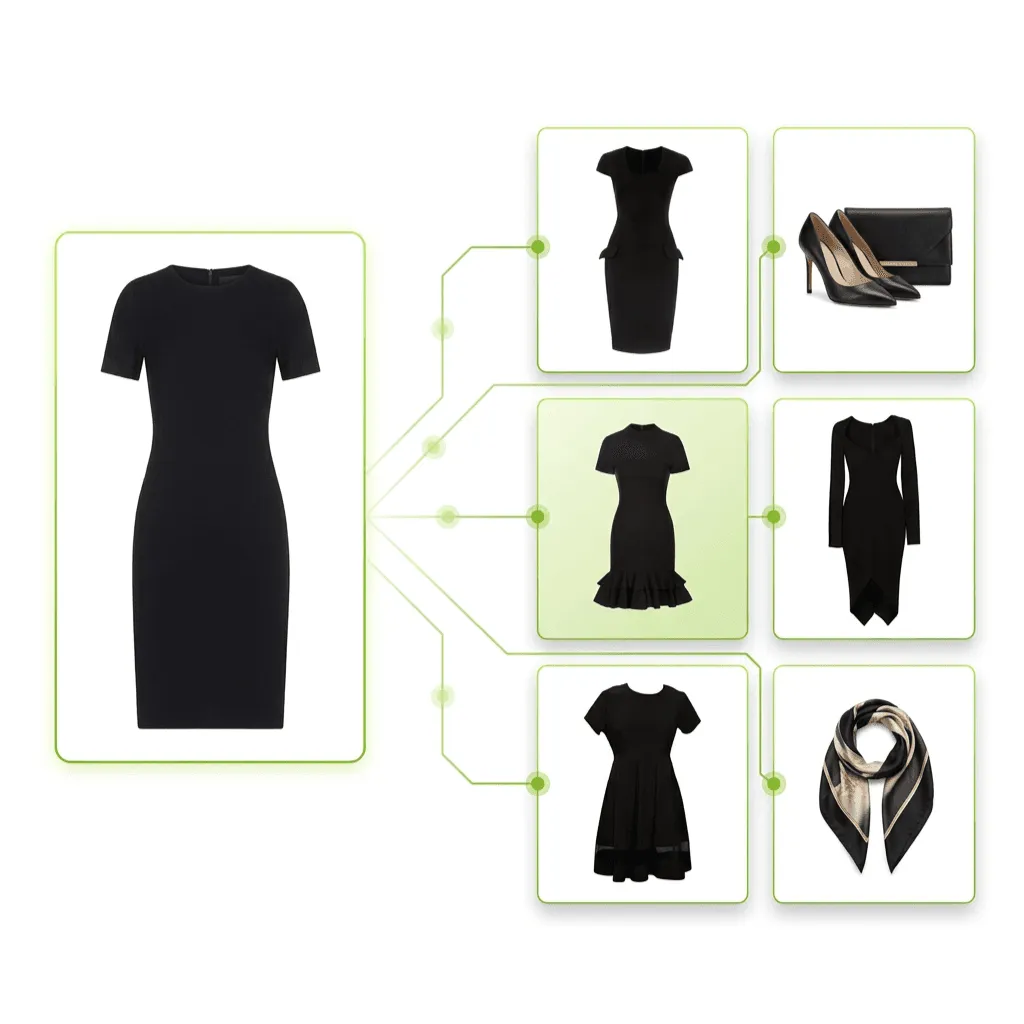
Beyond a single product page
Turn product interest into broader catalog exploration
A product page answers one immediate question: “Is this the product I want?” It does not always answer the next one: “What else should I consider?”
Shoppers may want to compare a product with visually or functionally similar alternatives, find related items, or continue exploring a category without starting their search again. Product discovery recommendations can provide these additional paths directly within the shopping experience.
Similar products and broader recommendations serve different purposes. Similar products focus on alternatives that share meaningful characteristics with the product being viewed. They can help shoppers compare options when the current product is close to what they want but not quite right. Recommendations is a broader term for product suggestions presented in a particular context, such as a product page, search experience, category page, or another catalog surface.
The right experience depends on the catalog, page context, merchandising objectives, and available product data. Visidea can be used to add recommendation and similar-product experiences to an ecommerce product-discovery strategy without requiring shoppers to leave the current journey.
See it in context
Explore recommendations around a product
See how similar-products or recommendation module can extend product exploration from the current catalog context.
Functional cookies are off — turn them on to play this video.
Product discovery
More ways to explore the catalog
Recommendations can create additional navigation paths around products and catalog content. Each surface should be configured and evaluated according to the ecommerce site's catalog structure and user experience.
-
Similar product discovery
Help shoppers examine alternatives to the product currently in view. Similar-product experiences are particularly useful when a shopper is comparing options or when the displayed product does not fully match their requirements.
-
Related product exploration
Give shoppers another route into relevant catalog items from the context of a product or page. Related products can extend exploration beyond direct alternatives while keeping the shopper within the existing ecommerce journey.
-
Better catalog navigation paths
Product discovery does not have to begin and end with menus, filters, or search boxes. Recommendation modules can create additional connections between catalog items and give shoppers more opportunities to move from one relevant product to another.
-
Contextual discovery surfaces
Recommendations can be presented in different parts of an ecommerce experience depending on the site's UX and commercial objectives. You can evaluate which contexts—such as product pages or search experiences—provide useful additional discovery opportunities.
Product Discovery in Action
Give shoppers alternatives without restarting their search
Problem
A shopper can find a product that is close to what they need but still have unanswered questions. The color may not be right, another size or style may be preferred, or the shopper may simply want to compare several options before deciding. Without another discovery path, the shopper may return to a category, repeat a search, or leave the product journey entirely. You need to consider how shoppers can move from one relevant catalog item to another without adding unnecessary navigation steps.
Solution
A similar-products experience can place relevant alternatives directly alongside the product being viewed. Broader recommendation modules can provide additional related catalog options where appropriate. Together, these surfaces can make product exploration more continuous: shoppers can compare, return to the original product, or continue browsing without rebuilding their search from the beginning. The appropriate configuration depends on catalog structure, product attributes, page context, availability rules, and the site's existing UX.
- Similar Products CTR 12.6%
Percentage of shoppers who click a product displayed in the similar-products module.
- Products Discovered per Session 1.66
Average number of distinct product detail pages viewed per shopping session.
- Recommendation Coverage 99.9%
Percentage of eligible product detail pages that display at least one recommendation module with available products.
Where to place discovery modules
Match each recommendation surface to its page context
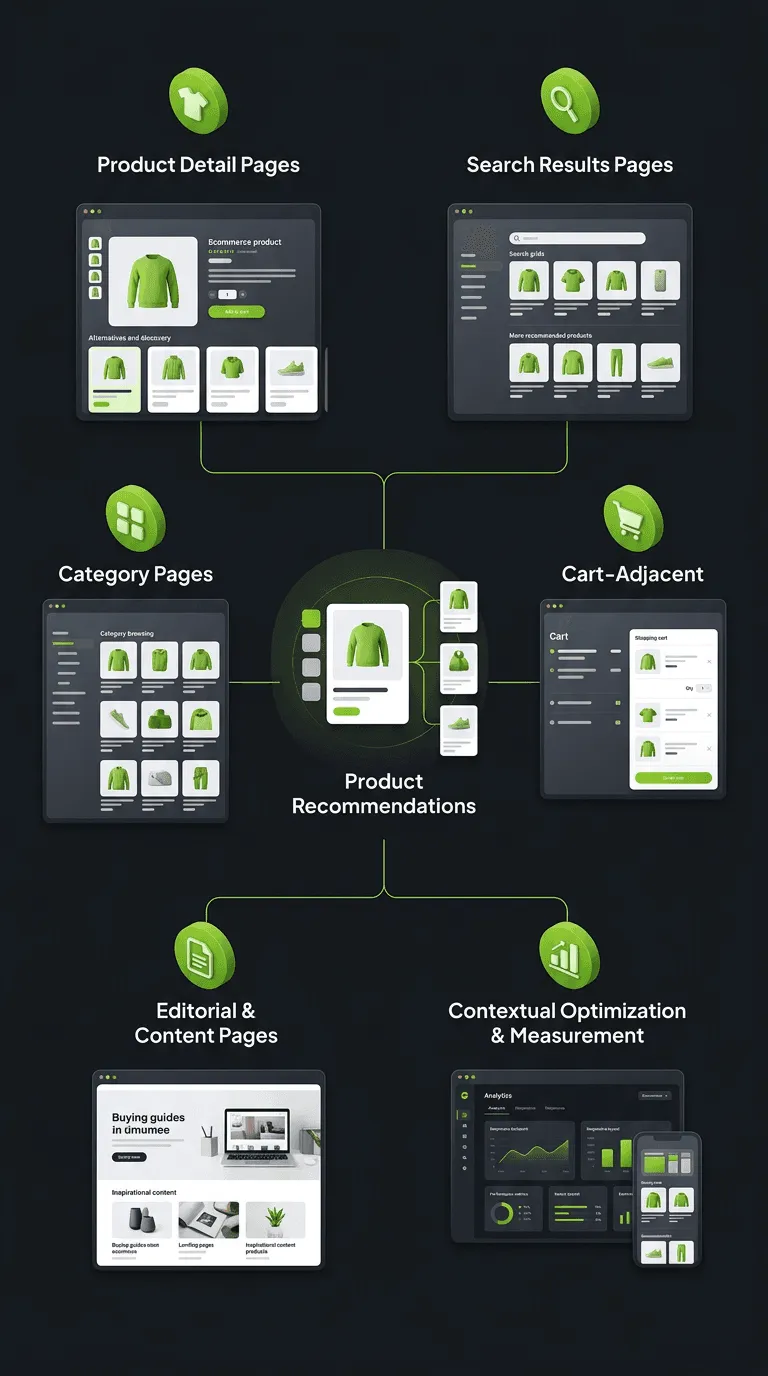
Product detail pages are a natural location for similar products because shoppers already have a specific catalog item in mind. A recommendation module can present relevant alternatives without requiring shoppers to return to search or category navigation.
The homepage is another opportunity to introduce product recommendations. Modules can showcase selected catalog items, highlight product collections, or provide additional discovery paths as shoppers begin their browsing journey.
Search results and category pages can also support product exploration, particularly when shoppers want to discover more options within a specific query or product category. Recommendation modules should complement rather than compete with the primary navigation experience.
Cart-adjacent experiences can introduce related products in the context of a shopper's current selection. The thank-you page, displayed after an order is completed, can provide another opportunity to continue product discovery by presenting relevant products for future exploration.
Editorial content, buying guides, landing pages, and other content-led experiences may also offer useful contexts for recommendations when products are part of the page experience.
Placement should not be treated as a universal rule. You should consider each page's purpose, available catalog context, visual hierarchy, mobile experience, inventory constraints, and commercial objectives. Recommendation placement should be validated through appropriate measurement rather than assuming that adding a module will improve performance.
Evaluation checklist
What to evaluate before implementation
A useful recommendation experience starts with the catalog and the context in which products are presented. Before implementation, you should define what constitutes a relevant product relationship, which catalog fields are available, and how unavailable products should be handled.
The evaluation should cover both relevance and experience. A technically functional module may still perform poorly if its products are difficult to compare, appear in the wrong context, or create unnecessary visual competition with the primary page content.
- Catalog structure: Check that product IDs, categories, attributes, descriptions, images, and other relevant catalog fields are consistently structured.
- Stock and availability: Establish rules for unavailable, discontinued, hidden, or otherwise non-purchasable products.
- Relevance rules: Define what makes an item similar, related, or appropriate for a particular recommendation context.
- Page context: Determine which product, search, category, cart, or content context should influence the products displayed.
- User experience: Review module placement, product-card design, mobile behavior, navigation, accessibility requirements, and interaction with existing merchandising components.
- Measurement: Define the events and business metrics needed to evaluate impressions, interactions, downstream product exploration, and other agreed objectives.
Frequently asked questions
Product recommendations and similar products FAQ
What are product recommendations in ecommerce?
Product recommendations are product suggestions presented within an ecommerce experience to give shoppers additional catalog options. They can appear in contexts such as product pages, search results, category pages, cart-adjacent experiences, or editorial content. The purpose and relevance criteria depend on the specific page context and ecommerce strategy.
What are similar products?
Similar products are alternatives that share relevant characteristics with a product a shopper is currently viewing. They are commonly used when shoppers want to compare options or continue exploring products that are close to their current selection. What qualifies as “similar” depends on the catalog and the rules or technology used to establish product relationships.
Where should similar products appear on an ecommerce site?
Product detail pages are a common location because shoppers already have a specific product as their reference point. Similar products can also be considered in search and other discovery contexts. The appropriate placement depends on the site's UX, catalog structure, page purpose, inventory rules, and commercial objectives.
How do recommendations support product discovery?
Recommendations provide additional paths between products and can reduce the need for shoppers to restart navigation after viewing an item. Depending on the context, they can help shoppers compare alternatives, discover related catalog items, or continue exploring products from the current page.
What catalog data is needed?
The required data depends on the recommendation experience and integration approach. Relevant catalog information can include product IDs, names, descriptions, categories, attributes, images, URLs, variants, and availability information. The exact data requirements should be confirmed for the intended implementation and catalog structure.
How should I measure recommendation performance?
You should define measurement around the purpose of each recommendation surface. Useful measures can include module impressions, interactions with recommended products, subsequent product exploration, and other agreed ecommerce objectives. The measurement framework should account for page context and establish a baseline where appropriate.
Explore product discovery
Build a broader product discovery experience
Product discovery for ecommerce
See how recommendations can fit your catalog
Discuss your catalog, ecommerce platform, and product-discovery goals with the Visidea team. A demo can help you evaluate where similar products and recommendation experiences could fit within your existing shopping journey.