
Semantic Search for ecommerce
Help shoppers find products by what they mean
Semantic Search for ecommerce helps shoppers discover products using descriptive language rather than relying only on exact keyword matches. It connects shopper intent with the concepts represented in a product catalog, helping ecommerce teams address more natural product searches and long-tail queries.
What is Semantic Search?
Search for meaning, not only matching words
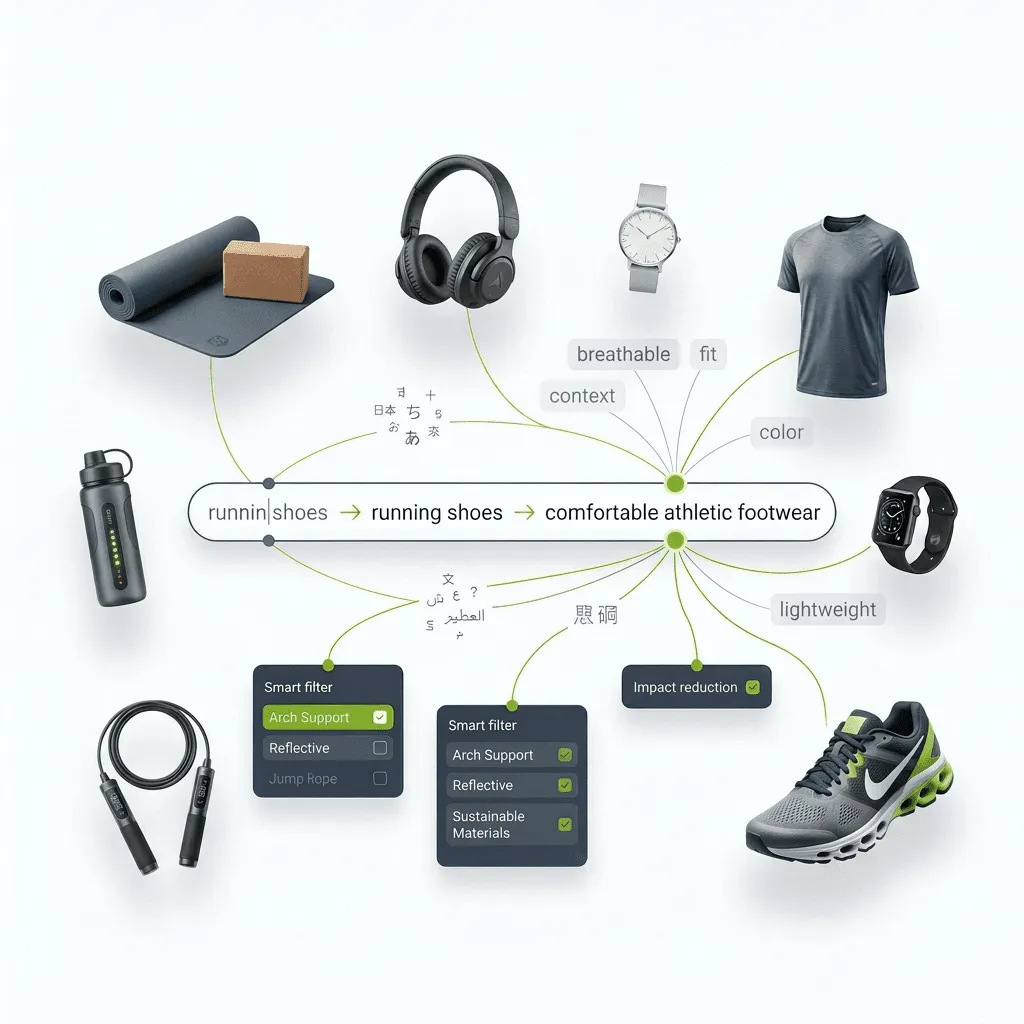
Semantic Search for ecommerce is an approach to product search that focuses on the meaning and intent behind a shopper’s query, rather than depending only on exact word matches. Instead of treating a query as a collection of isolated terms, Semantic Search can relate descriptive language to concepts represented in a product catalog.
This matters because shoppers do not always use the same vocabulary as an ecommerce catalog. A product may be described using specific attributes, while a shopper uses everyday language, a broader category, or a combination of requirements.
Exact keyword matching can work well when the shopper knows the product name or uses terminology that closely matches the catalog. It can become less useful when the query is incomplete, descriptive, or expressed differently from the product data.
A shopper searches for “black formal shoes for a summer wedding.” The catalog may contain products described with terms such as “black leather,” “dress shoes,” and “occasion footwear.”
A shopper searches for “a compact table for a small dining room.” The catalog may contain dimensions, product categories, materials, and room-related attributes that provide useful context for interpreting the request.
The practical question is not simply whether a search engine is “semantic.” It is whether it produces relevant results for the language shoppers actually use in a specific catalog.
Explore the Semantic Search flow
See how a natural-language query can become product discovery
The Semantic Search experience starts with the shopper’s words and connects the query with information represented in the catalog. The exact behavior depends on the search implementation, catalog structure, and configuration.
Functional cookies are off — turn them on to play this video.
Support more natural product discovery
Make product search closer to the way shoppers describe what they need
Ecommerce search has to connect shopper language with catalog language. Semantic Search can provide an additional layer for handling descriptive queries, helping you investigate where conventional matching may leave gaps and where shoppers need a clearer route from intent to relevant products.
-
Interpret descriptive shopper language
Shoppers may describe a product using use cases, characteristics, contexts, or combinations of requirements rather than an exact product name. A semantic approach provides a way to evaluate these descriptions as expressions of intent instead of relying exclusively on literal word overlap.
-
Surface relevant catalog concepts
Product discovery depends on the information available in the catalog. Semantic Search can connect the language in a shopper’s query with relevant concepts represented in product names, descriptions, attributes, or other catalog information, subject to the quality and structure of that data.
-
Complement conventional search
Semantic Search does not have to replace existing search methods. You can evaluate it as another component of the ecommerce search experience, particularly for descriptive or long-tail queries where literal matching may not fully represent the shopper’s intent.
-
Create clearer paths to products
A useful search experience should help shoppers move from a request to a set of products they can evaluate. Semantic Search can support this journey by providing a way to connect natural-language requests with catalog concepts and relevant product results.
Connect shopper intent with your catalog
Bridge the gap between shopper language and catalog terminology
Problem
Ecommerce catalogs often contain structured product names and descriptions, while shoppers may search using incomplete phrases, everyday terminology, or combinations of requirements. A shopper might know the type of product they need without knowing the terminology used in the catalog. They may also describe a use case rather than a product name, or combine several attributes in one long-tail query. Exact keyword matching can struggle when important concepts are expressed differently between the query and the available product data. These gaps make product search relevance a catalog-specific problem: the same search approach can behave differently depending on product information, taxonomy, terminology, and query patterns.
Solution
Semantic Search provides a way to evaluate shopper queries according to their meaning and relationship to the information represented in the catalog.
For you, the implementation should be assessed using real product data and real or representative shopper queries. This includes examining how product titles, descriptions, attributes, categories, and other available information contribute to relevance. You can then identify query types where semantic interpretation may complement conventional matching and establish a process for reviewing results. The objective is not to assume that every natural-language query will produce a useful result, but to create a search experience that can be tested against the vocabulary and intent patterns of a specific ecommerce catalog.
- Long-Tail Queries 8.63%
Share of ecommerce searches that can contain multiple words or specific combinations of requirements.
- Query–Catalog Mismatch 68.2%
Queries where shopper terminology differs from the product language represented in the catalog.
- Search Relevance 65.8%
Share of evaluated queries for which the returned products are judged relevant to the shopper’s intent.
What makes Semantic Search useful?
Evaluate semantic search against your actual catalog
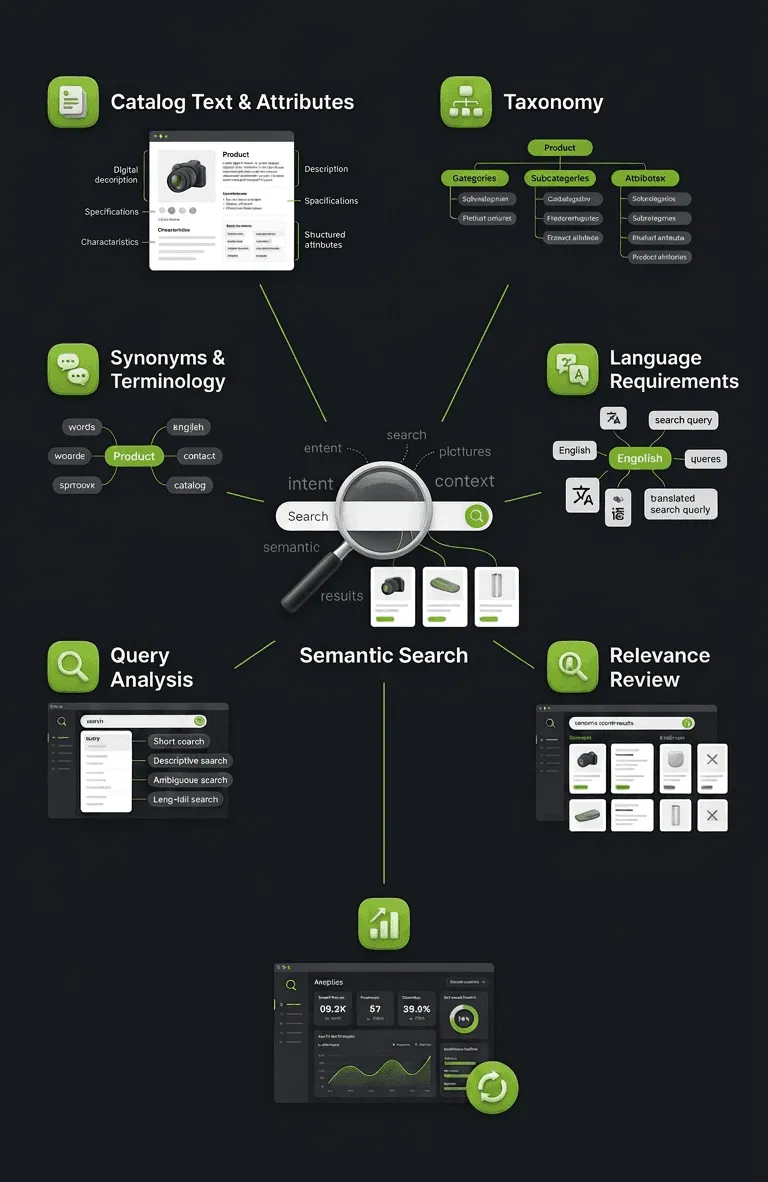
The value of Semantic Search depends on how well it works with a specific catalog and its shoppers. Before selecting or configuring a solution, ecommerce and technical teams should validate at least seven areas.
- Catalog text and attributes. Review which product information is available and how consistently it describes important characteristics. Search quality is constrained by the information available to the search system.
- Taxonomy. Examine categories, product types, attributes, and relationships. A consistent taxonomy can provide important context for product discovery.
- Synonyms and terminology. Identify differences between the words shoppers use and the terminology used by merchandising and catalog teams.
- Language requirements. Define the languages shoppers use and determine how multilingual queries and catalog content need to be handled. Validate this against representative data rather than assuming coverage.
- Query analysis. Study real searches, including incomplete, descriptive, ambiguous, and long-tail queries. Separate queries that already perform well from those where relevance is problematic.
- Relevance review. Create representative query sets and assess whether returned products satisfy the intended request. Include edge cases and ambiguous queries.
- Measurement and iteration. Establish how search quality will be monitored and how relevance issues will be investigated over time.
The most important validation step is testing against a real catalog and representative search queries. Generic demonstrations can explain the concept, but they cannot establish how semantic search will behave for a particular ecommerce business.
Semantic and visual discovery
Give shoppers different ways to start product discovery
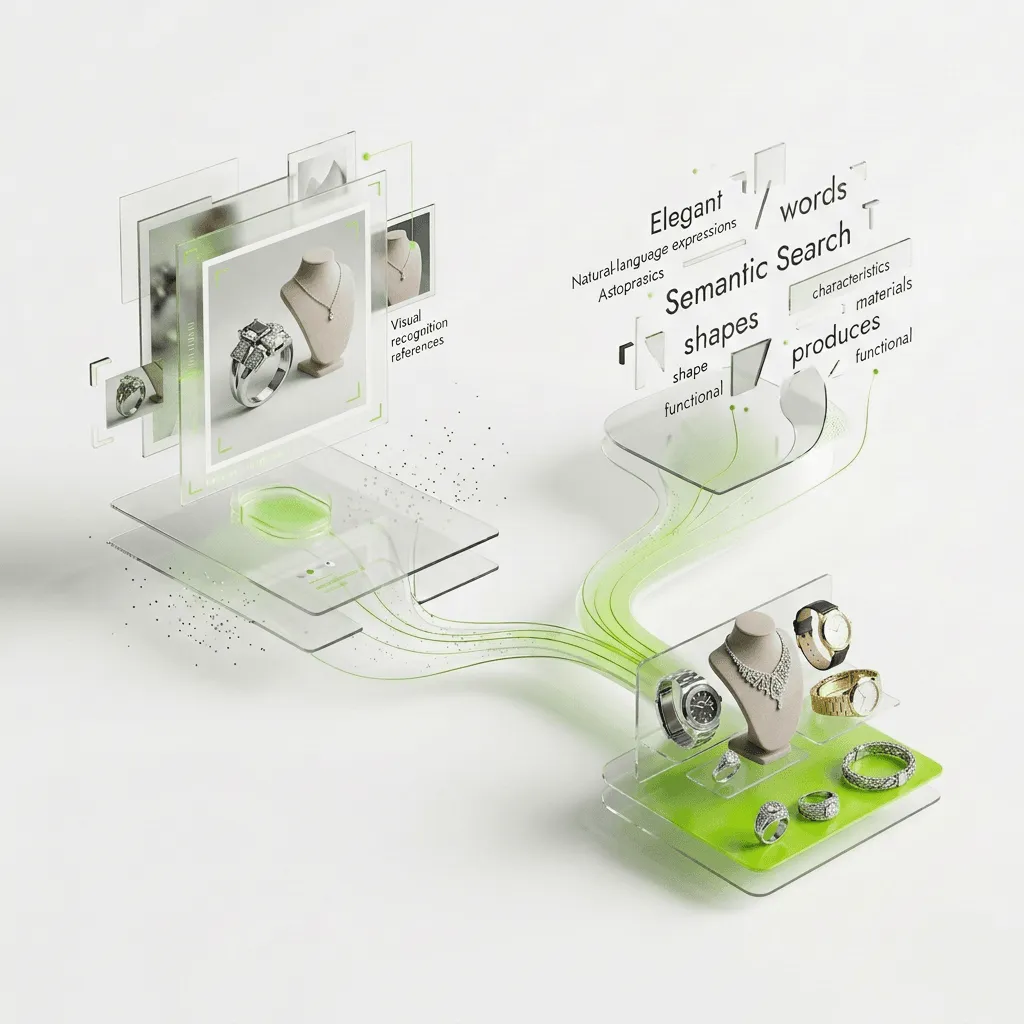
Shoppers do not always begin product discovery with the same type of information. A shopper who knows what they want may start with words: a product category, a set of characteristics, a use case, or a more descriptive request. Semantic Search is designed to address this type of text-based discovery.
Another shopper may start with an image. They might have seen a product they like, saved a photograph, or want to find visually similar items without knowing the product’s name or the terminology used in the catalog. Visual Search addresses this image-led discovery scenario.
These approaches solve different parts of the search journey. Semantic Search starts from language and product concepts; Visual Search starts from visual information. Depending on the catalog and customer journey, you can evaluate them as complementary discovery mechanisms rather than treating one as a universal replacement for the other.
Learn more about image-led product discovery with Visidea Visual Search.
Semantic Search FAQ
Questions ecommerce teams ask about semantic search
What is Semantic Search in ecommerce?
Semantic Search in ecommerce is an approach to product search that focuses on the meaning and intent of a shopper’s query rather than relying only on exact keyword matches. It connects natural-language requests with concepts represented in product catalog data.
How is Semantic Search different from keyword search?
Keyword search primarily looks for relationships between query terms and indexed catalog text. Semantic search focuses more on the meaning and context represented by the query and catalog. The practical difference should be evaluated using representative queries and products from the specific ecommerce catalog.
Can Semantic Search understand natural-language product queries?
Semantic Search is designed to handle queries expressed as natural language rather than requiring shoppers to use exact product terminology. How well it handles a particular query depends on the search implementation and the information available in the catalog, so representative queries should be tested before deployment.
What catalog information affects search relevance?
Product names, descriptions, attributes, categories, taxonomy, and other available catalog information can affect relevance. The importance of each field depends on the catalog and search implementation. Teams should evaluate these inputs using real products and representative queries.
Does semantic search replace filters and category navigation?
Not necessarily. Search, filters, and category navigation serve different roles in product discovery. Semantic search can be evaluated as a complementary search mechanism, while filters and navigation can help shoppers refine or browse the available catalog.
How should I evaluate search quality?
Start with representative queries from the real customer journey. Include exact product searches, descriptive queries, incomplete phrases, long-tail requests, ambiguous terms, and important catalog categories. Review the relevance of returned products, document failure cases, and establish a process for measuring and iterating on search quality.
Can Semantic Search and Visual Search be used together?
Yes, they can represent complementary discovery paths: semantic search starts with words and visual search starts with an image. Whether and how they should be combined depends on the ecommerce journey, catalog, technical architecture, and implementation requirements.
Explore product discovery
Related Visidea resources
Evaluate Semantic Search
See how Semantic Search could fit your ecommerce catalog
Book a demo to discuss your product catalog, search experience, and requirements. Use the conversation to explore relevant search scenarios and determine what should be validated with your own data.