
Visidea Platform
Ecommerce product discovery for different shopper starting points
Visidea is an ecommerce product-discovery platform for ecommerce teams choosing how shoppers find and explore products. Its services address discovery through images, natural-language search, product recommendations, conversation, and email. Explore which capabilities fit your catalog and customer journey, then define the commercial and integration scope relevant to your business.

What is ecommerce product discovery?
Help shoppers move from a starting point to relevant products
Ecommerce product discovery is the process through which shoppers find, explore, and assess products in an online catalog. It includes finding a known item and working out which product could meet a less defined need.
A shopper might arrive with an exact product name, a descriptive requirement, a reference image, a category to browse, or a product they are already viewing. Each starting point calls for a different way to explore.
Search gives shoppers a place to express what they want. Navigation organizes the catalog, while filters narrow a selection. Product information helps shoppers judge suitability. Recommendations introduce further products to consider, and conversational or image-led experiences offer other ways to express a need.
The appropriate route depends on shopper intent and the catalog: what the products are, how they differ, and how clearly those differences are described or shown.
Visidea offers product-discovery services within this broader storefront experience. Evaluating its role means identifying where a particular service could support your existing search, browsing, and product exploration journeys.
See the platform in context
From an initial need to product exploration
Explore the different ways product discovery can begin: a description, a reference image, or a product already under consideration. This overview introduces the role of search, recommendations, conversation, and email, illustrating how each approach relates to a shopper’s starting point and the choices an ecommerce team needs to assess.
Functional cookies are off — turn them on to play this video.
Explore the services
Five ways to approach product discovery
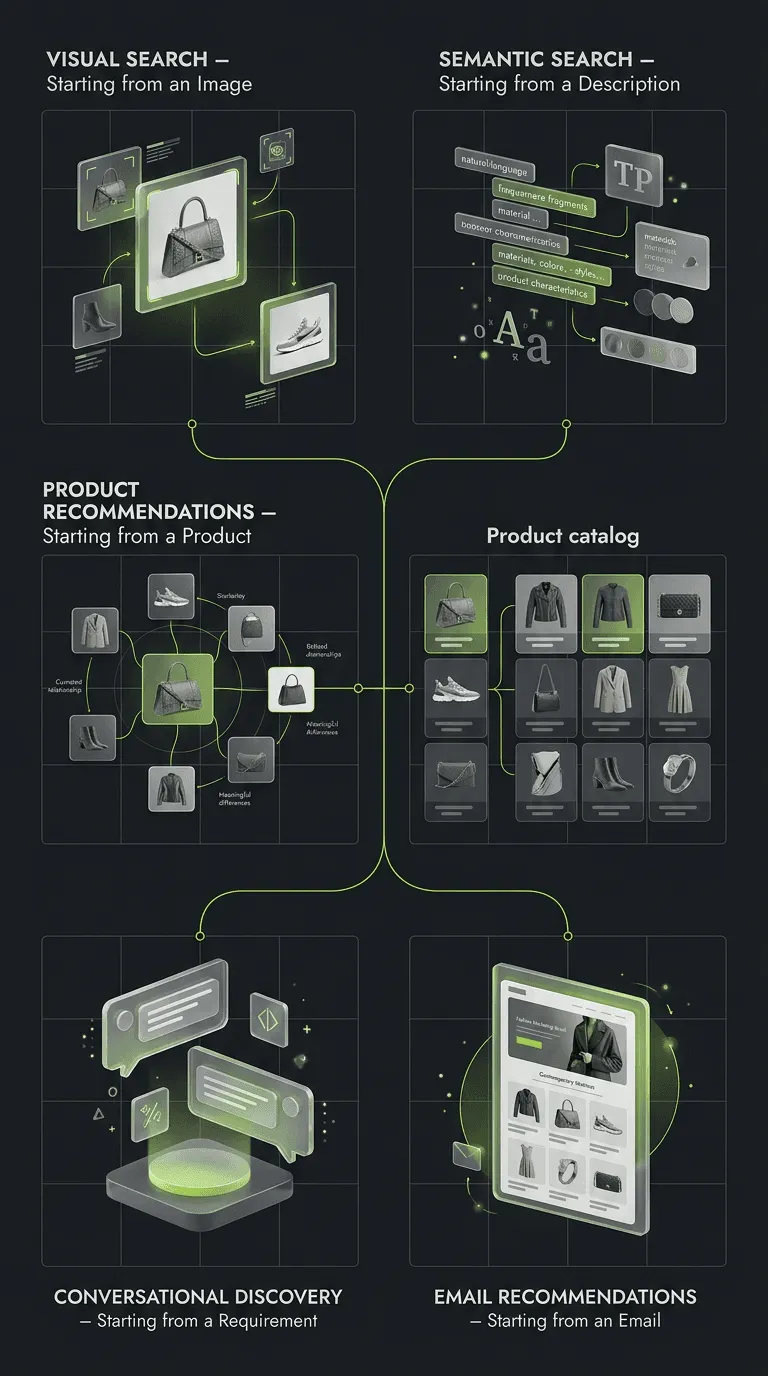
The entry point shapes the experience: an image provides a visual reference, a query expresses a need, and a product provides context for further exploration. Conversation and email create additional opportunities to consider products. The service summaries below explain the role of each discovery method.
-
Visual Search
Visual Search for ecommerce uses an image as the starting point for finding visually similar products. It gives shoppers a way to explore a catalog when a reference picture expresses what they want more clearly than a product name. Explore Visidea’s Visual Search service and its available scope.
Discover Visual Search -
Semantic Search
Semantic Search for ecommerce focuses on the meaning of a query. Shoppers can express a need in descriptive or natural language to find products. Explore Visidea’s Semantic Search service when the evaluation centers on how shoppers describe requirements and how those descriptions relate to your catalog.
Discover Semantic Search -
Product Recommendations
Ecommerce Product Recommendations introduce related products or alternatives for shoppers to consider. They support exploration when a shopper has found a starting point but still wants other options. Explore Visidea’s Product Recommendations service to discuss the recommendation experience, its intended placement, and the product relationships relevant to your business.
Discover Product Recommendations -
Conversational Agent
Conversational product discovery gives shoppers a dialogue-based way to express product needs. A conversational interface organizes the interaction as an exchange of messages, while a conventional search input centers on a submitted query. Explore Visidea’s Conversational Agent to assess where conversation could fit your shoppers’ discovery needs.
Discover Conversational Agent -
Email Recommendations
Email product recommendations place product suggestions within an email discovery journey, giving recipients products to consider when returning to a store. Explore Visidea’s Email Recommendations service to discuss this use case, how recommendations would fit your email workflow, and the responsibilities of your existing email-service provider.
Discover Email Recommendations
Match the experience to the shopper’s starting point
Match each discovery method to a specific situation
These illustrative situations describe discovery methods to evaluate, rather than verified Visidea workflows. Each is a separate use case; combining services requires its own scope and integration assessment. Use the examples to identify where a shopper needs another way to explore your catalog.
- A shopper has a reference image. Visual Search makes that image the starting point for exploring visually similar products. The evaluation should consider the kinds of reference images shoppers bring and the product imagery available in the catalog.
- A shopper can describe a need but not a product name. Semantic Search provides a route through descriptive language. Review representative queries alongside product information to judge whether the experience presents options relevant to the stated need.
- A shopper is viewing a product and wants alternatives. Product Recommendations introduce other items to consider. Define what makes an alternative useful in that context, including meaningful differences shoppers need to assess.
- A shopper needs a conversational way to express a product requirement. Conversational discovery frames the interaction as dialogue. Assess which requirements shoppers need to communicate and what information would make the exchange useful.
- A shopper returns through an email containing product suggestions. Email recommendations provide a starting selection for further exploration. Assess the relevance of the suggestions and the destination experience alongside your existing email workflow.
Catalog and integration
Assess your catalog and the experience you need to build
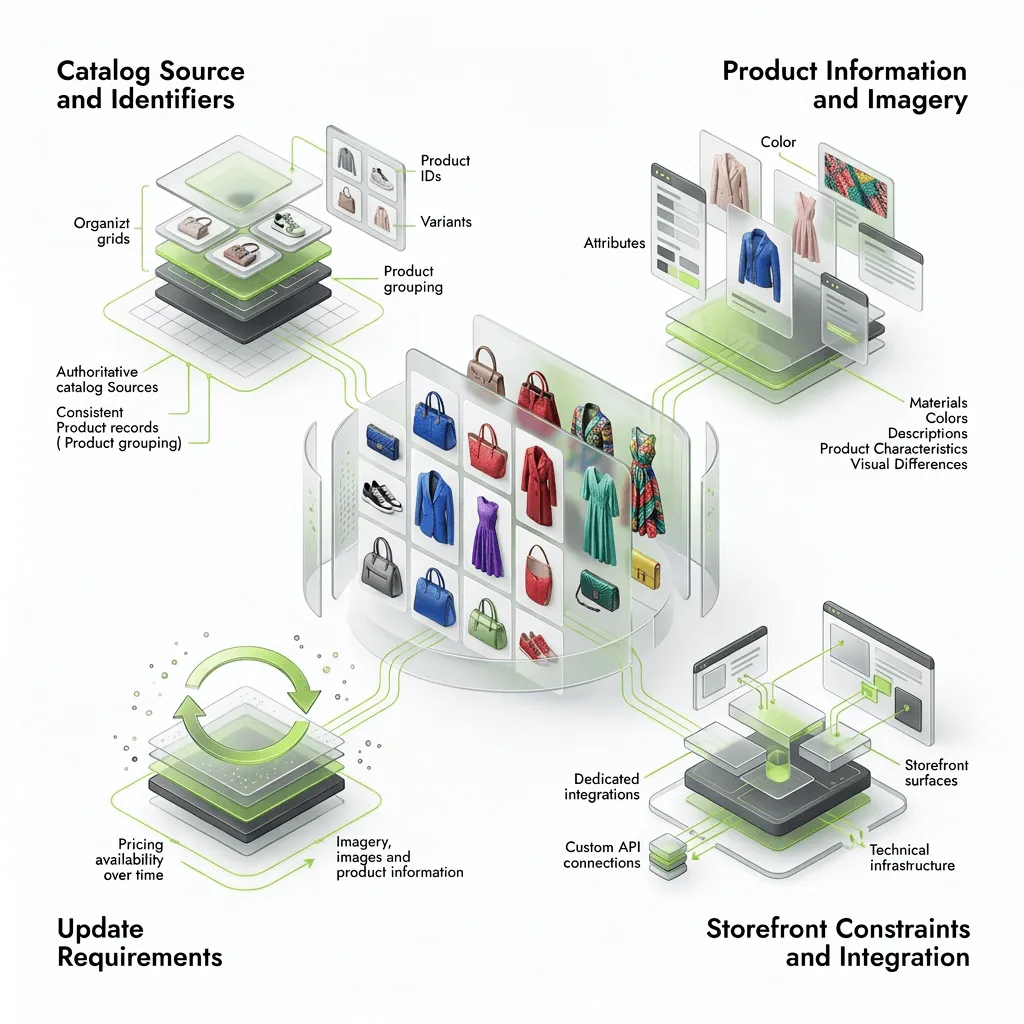
Discovery quality and implementation scope depend on the actual catalog, product information, imagery, customer-facing surfaces, and technical environment. Begin with an assessment of those inputs and constraints. The areas below are planning considerations, rather than a specification of mandatory Visidea fields or ingestion requirements.
- Catalog source and identifiers: Identify where product records are maintained and how your business distinguishes products and variants. Establish which source is authoritative when records differ.
- Product information and imagery: Review the attributes, descriptions, and images relevant to the selected discovery method. Check whether they communicate the differences shoppers need to evaluate.
- Update requirements: Document which information changes, how frequently it changes, and how current the intended experience needs to be. Confirm supported update behavior during technical scoping.
- Storefront constraints: Identify where the experience should appear, who owns that surface, and what restrictions affect changes to it. Include the teams responsible for implementation and ongoing maintenance. Investigate dedicated integrations for your environment and custom API integration where a custom approach may be relevant. Confirm availability and fit for the selected service before choosing a path. A useful technical discussion starts with representative catalog examples, the intended shopper interaction, and a clear account of your existing systems.
Start with a focused evaluation
Define the use case before expanding the scope
A focused evaluation connects a shopper problem to a specific experience and a way to judge its usefulness. Agree on that scope across ecommerce, merchandising, and technical teams before discussing a broader rollout.
- Identify the discovery problem. Describe where shoppers struggle and what they are trying to accomplish. Use concrete examples, such as a descriptive query or a product page where alternatives would be useful.
- Review the catalog and customer journey. Examine representative products, available information, and the surface where discovery should happen. Identify gaps or constraints that could affect the proposed experience.
- Select the relevant capability and integration scope. Choose the service that addresses the problem and investigate how it could fit your environment. Review pricing and available options as part of confirming the commercial scope.
- Define how the experience will be evaluated. Choose criteria that reflect the selected experience and business goal. Search may call for relevance review across representative queries; recommendations may call for assessing the usefulness of suggested alternatives. Establish what evidence you can collect through your available tools and processes.
Frequently asked questions
Understanding the Visidea platform
What is the Visidea platform?
Visidea is an ecommerce product-discovery platform for businesses evaluating how shoppers find and explore products. Its services include Visual Search, Semantic Search, Product Recommendations, Conversational Agent, and Email Recommendations. Each addresses a different discovery context. The appropriate scope depends on your shopper needs, catalog, commercial options, and technical environment.
How do Visidea’s product-discovery services differ?
The services differ by the discovery method they address. Visual Search starts with an image; Semantic Search addresses descriptive queries. Product Recommendations supports related-product and alternative-product exploration. Conversational Agent provides a dialogue-based approach, while Email Recommendations concerns product suggestions in email journeys. These methods may complement one another when their individual roles and integration scope are defined.
Do we need to use every Visidea service?
You can begin your assessment with one shopper problem and the service most relevant to it. A focused scope makes it easier to define the intended experience and evaluation criteria. Discuss which services are available for that scope with Visidea; any decision to combine capabilities should follow a clear customer need and confirmed commercial and technical fit.
What catalog information should we review before integration?
Review your catalog source, product and variant identifiers, relevant attributes, descriptions, imagery, and update requirements. Also identify where the discovery experience should appear and any storefront constraints. These are assessment areas, not a confirmed list of Visidea ingestion requirements. The required information and supported handling must be established for the service and integration path you select.
Can Visidea be evaluated for a custom ecommerce platform?
A custom ecommerce platform is a use case to discuss with Visidea. Start by reviewing the custom API integration path and sharing your catalog structure, intended shopper experience, and technical constraints. Compatibility, available interfaces, implementation responsibilities, and service-specific requirements need confirmation before your team can determine whether the proposed approach fits.
Are all services included in every subscription?
Subscription inclusions need to be confirmed for the option you are considering. A platform overview describes the services available to explore; it does not establish what a particular subscription includes. Review pricing and available options, then confirm the selected services, any applicable add-ons, and the integration scope with Visidea before making a purchasing decision.
Find the right discovery experience
Discuss product discovery for your catalog and customer journey
Bring your catalog context, shopper journey, and ecommerce stack to a conversation with Visidea. Discuss the discovery problem you want to address, the capabilities most relevant to your business, and the integration questions your team needs to resolve when assessing a suitable scope.